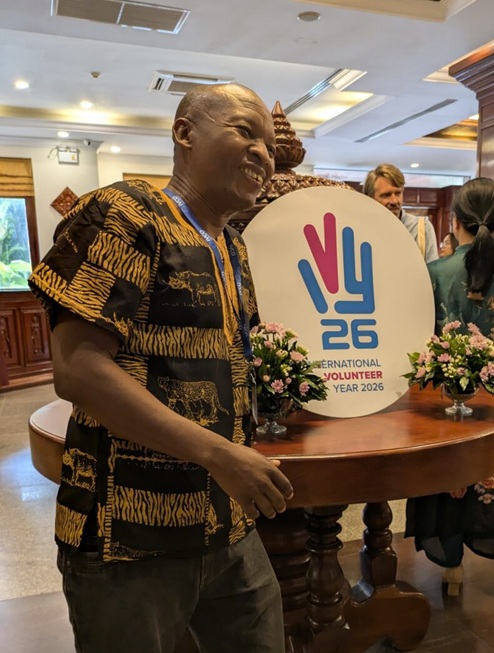

Think Piece Authors: Ratherford Mwaruta, National Coordinator of the Zimbabwe Workcamps Association
International Voluntary Service (IVS) has undergone a notable evolution since the post-World War II era, particularly influenced by modernisation theory. This theory proposed a development model categorising nations as ‘poor’, requiring support from the Global North. Such structured aid aimed to eradicate poverty while establishing a development discourse in the Global South through skill transfer, financial assistance, and technology. However, this approach has contributed to the process of ‘othering’, as described by Edward Said. Othering shapes perceptions of those outside the dominant culture as exotic and inferior, reinforcing a dichotomy between the Global North and South. Scholars have argued that North-South volunteering often perpetuates this mindset, portraying individuals in the Global South as the other, and diminishing their agency.
While IVS is essential in promoting cross-cultural understanding through direct encounters and knowledge exchange, it largely operates within a traditional framework that does not sufficiently address the evolving nature of international volunteering. In recent decades, there has been a shift towards national and South-South volunteering, highlighting localisation, reciprocity, and community-led initiatives. Nevertheless, a critical question remains: do underlying power inequalities continue to exist? The prevailing power dynamics between North and South have been examined and debated by academics and practitioners. The North continues to regard the South from a position of power, portraying it as dependent on Northern resources, while in reality both regions rely on one another. This situation creates a perception where the South appears as a periphery to the North, and contributes to an uneven power dynamic in partnerships, in both theory and practice. Many practitioners hail from the West, guided by ideologies that influence the production of new knowledge. Consequently, most international volunteer policy frameworks are constructed through a Western lens, impacting the quality of equal partnerships due to the biased data utilised in formulating these policies.
The South is often depicted as exotic or impoverished, and it struggles to counter this notion due to its internal divisions rooted in colonial history. As a result, the dominant narrative shapes reality in voluntary services. The landscape for IVS is uneven, with Northern organisations dominating the field and setting the rules of engagement, primarily due to superior resources. The majority of knowledge production centres reside in the North, granting it a comparative advantage over the South, which often lacks access to vital resources and struggles to meet the stringent standards imposed by gatekeepers. Since international policies are predominantly formulated in Europe, they often fail to account for the needs and aspirations of the South, which lacks the power to challenge these standards.
The perception that volunteering mainly flows from North to South solidifies the othering process. Although there is a modest movement of Southern volunteers, it pales in comparison to their Northern counterparts due to barriers like visa restrictions and socioeconomic disparities. The prevailing narrative often presents IVS programs as avenues for personal growth, particularly for middle-class volunteers, further indicating an imperialistic approach where the needs of Western volunteers overshadow those of the host communities.
This dynamic raises critical questions: How can international volunteering foster genuinely reciprocal partnerships amidst fundamentally unequal global systems? Even with evolved language and models regarding international cooperation, it is vital to scrutinise the transformation in power distribution. Language control plays a significant role in this dynamic; the dominance of English as the industry standard disadvantages Southern voices, limiting their participation in mainstream academic discourse and perpetuating existing power imbalances. Furthermore, IVS often operates under a laissez-faire ideology that promotes competition based on supply and demand, exacerbating othering and undermining collaboration. The altruistic narrative frequently obscures the underlying neocolonial tendencies and historical legacy of exploitation.
In summary, the role of IVS in contemporary development showcases a complex relationship between altruism and historical power dynamics. While volunteering’s aspirations are commendable, it is essential to critically assess the ongoing effects of othering within these frameworks. A post-colonial lens facilitates a deeper understanding of how IVS interacts with the broader context of North-South relations and the lingering impacts of colonialism. Ultimately, the discourse surrounding international volunteering must pivot towards creating genuinely reciprocal partnerships that question existing inequalities and promote a more equitable, inclusive future for all involved.
Ratherford Mwaruta is the National Coordinator of the Zimbabwe Workcamps Association (ZWA) and a member of the Board of the Global Volunteering Forum. A community development practitioner committed to promoting international understanding through voluntary service, he has more than 25 years of experience in grassroots programmes at national and international levels including work with the Coordinating Committee for International Voluntary Services (CCIVS) and Southern Africa Workcamps Cooperation (SAWC). He is currently helping to develop the Network of African Voluntary Organisations (NAVO), a pan-African platform strengthening collaboration among voluntary organisations across the continent.